


WHAT EXPERTS SAY
Keynote Collection
Living With Cultures, Not Between Them
From Culture Shock to Cultural Expertise
Krystyna Konovalova

Living with different cultures instead of living in between them sounds like a catchy phrase on a self-help book cover. Let me show you what it actually looks like:
You start breakfast speaking German to your family, walk your children to their French-speaking school, stopping to discuss the best recipe for the traditional Geneva soup made every December. You hurry to your first job, teaching German in Switzerland— not just grammar, but the cultural finesse, because you know it from the inside. Then you head to your second job at an international organization, switching to English: coordinating translators worldwide, proofreading in French, Spanish, and German. On the way home, a Ukrainian comedy podcast — jokes that only make sense if you grew up in Kyiv in the 90s. Sometimes even my phone gets confused switching between languages.
I grew up in Ukraine and moved to Austria during high school — my first real culture shock. What struck me most was not the new dialect, but that language and culture are inseparable. Once you understand the language, you understand the people — why certain things are perfectly normal, and why others raise an eyebrow. I learned the way a child learns: by immersion, by making mental notes, by comparing everything to what I already knew. That is when I realized I wanted to study linguistics — to understand theoretically what I had already lived from the inside. Later, Slavistics explained the historical background of things I had simply experienced as a child in the post-Soviet world. Migration puts you at a crossroads: live between cultures — always regretting what you left, never fully arriving — or live with all of them, embracing what each offer, becoming an expert by comparison, not by judgment.
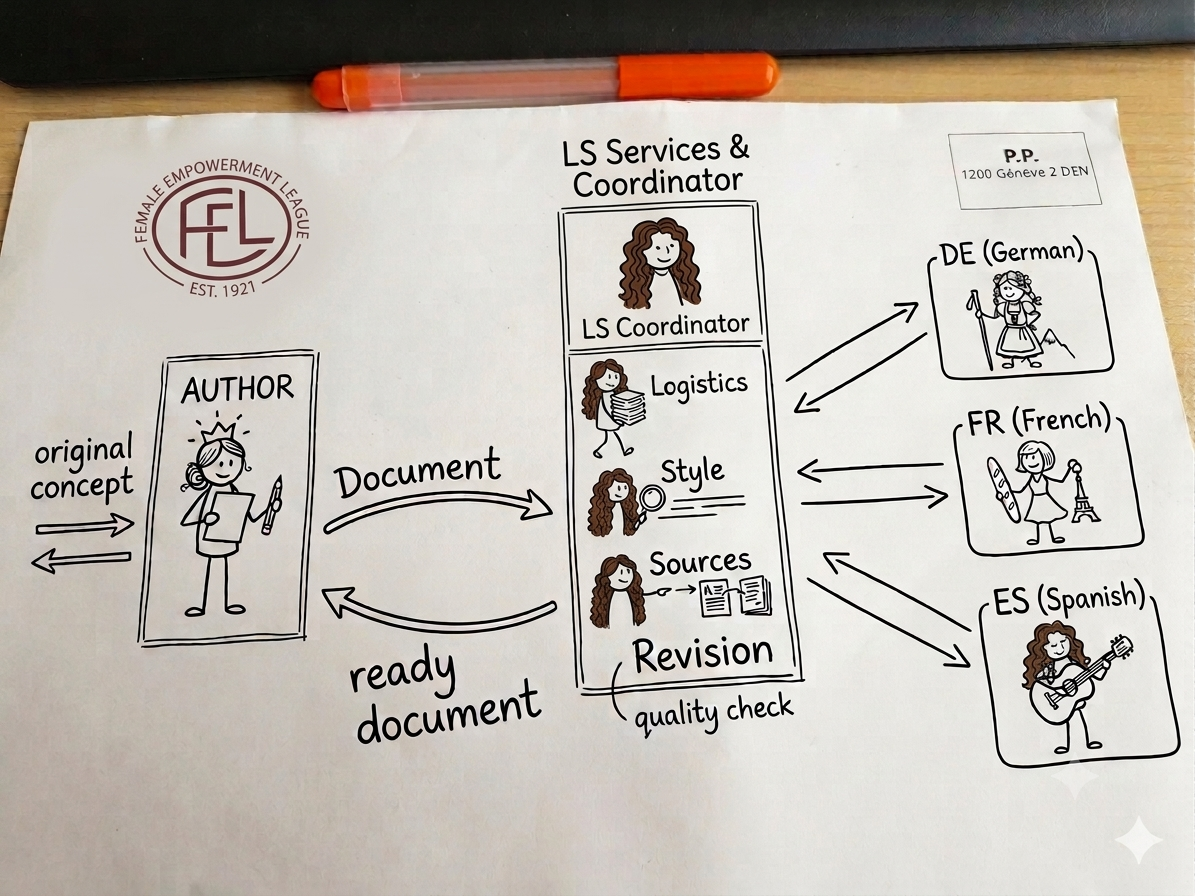
I chose the second path. I celebrate Ukrainian holidays, honor Austrian traditions, as well as Swiss ones that are part of my identity since my move to Geneva. Each language is a tone, that completes who I am. Think of your life as an embroidery: every stitch, every country, every experience adds something. The key is to commit. Never treat a country as a short-term station. Find the park you love. Learn to bake the local pie. Once you make it home, you own that experience — and can build on it. The cover of my agenda once said: "She believed she could, so she did." It describes exactly how I became a Language Service Coordinator. When I arrived in Switzerland, I was teaching German. One day I visited an organization for a trial lesson. Standing in front of a door marked "Language Service Coordinator", I thought: I have taught languages, translated in negotiations, written articles, researched, worked as a lexicographer, lectured at university. I should be behind that door. Three years later, I applied for that exact position — and got it.
To succeed: Look at your career not as a straight line but as a puzzle. Every piece counts — the internship, the part-time job, the skill developed on the side. Communicate with people and learn from their stories and experience. Give yourself time to feel at home. Try a local dish. Learn the local joke. Understand what people value and why.Take your multiculturality seriously. In a world where machines translate faster than ever, human understanding of culture, nuance, and context is what no algorithm can replace. Your languages are your professional superpower.
Figure out your talent and cultivate it. When your work is something, you truly love, you will never hate waking up for it.
"You can reach it if you want to reach it. Just never set the limits in your head."


ABOUT THE AUTHOR
Krystyna Konovalova
Geneva, Switzerland
krystyna.konovalova@gmail.com | LinkedIn